
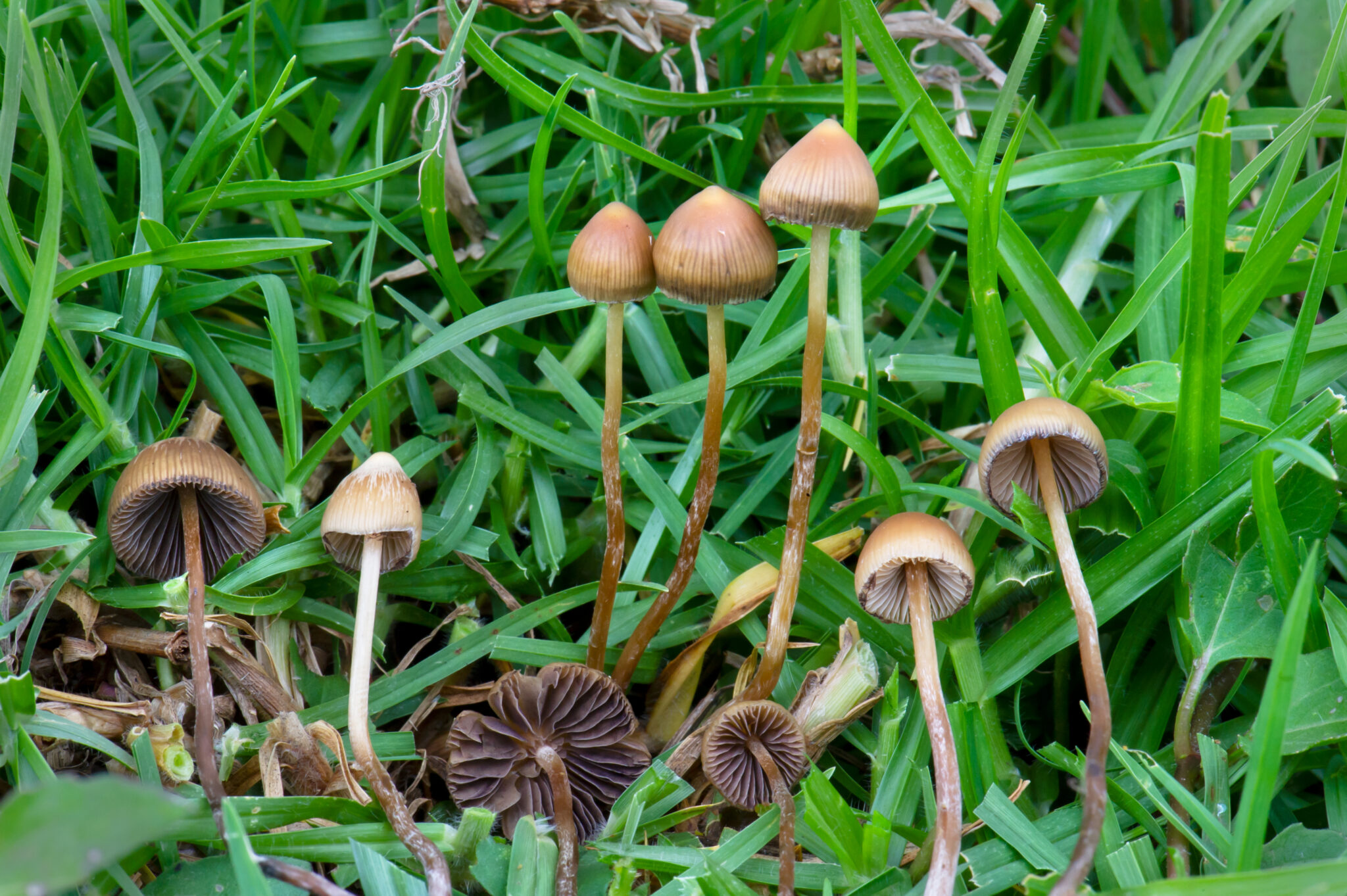
Few questions about fungi spark as much curiosity as this one: why did magic mushrooms evolve to produce psilocybin? For centuries humans have celebrated these organisms for their cultural, spiritual and therapeutic effects – but psilocybin didn’t evolve for us. Its origins lie far deeper, in nature’s own survival strategies.
Nature’s Curious Blueprint
Recent research has revealed something truly remarkable: different groups of mushrooms independently evolved the ability to make psilocybin using entirely different biochemical pathways. That means nature stumbled upon the same compound more than once, through different evolutionary routes. This kind of convergent evolution usually signals that a trait offers a real advantage.
But the big question remains – what advantage?
Psilocybin as a Survival Tool
One prominent scientific hypothesis is that psilocybin functions as a chemical defense mechanism. Many fungi produce specialized compounds to deter predators – especially insects and other small organisms that feed on them. Psilocybin and its breakdown products may disrupt nervous systems in sensitive animals, making the mushroom less appealing or harmful to eat.
In this view, psilocybin isn’t about creating mystical experiences for humans; it’s about survival for the fungus.
There’s also evidence suggesting that fungi allocate a surprising amount of energy – including nitrogen – to producing psilocybin. That alone hints that whatever role it plays, it must be beneficial enough to outweigh its metabolic cost.
More Hypotheses Than Answers
Scientists have floated other ideas too – such as psilocybin influencing animal behavior in ways that might help spread spores – but these explanations are still speculative and not yet backed by solid data.
What we do know is that psilocybin likely evolved long before humans ever encountered it. Many psilocybin-producing mushroom lineages date back tens of millions of years, suggesting its ecological functions pre-date our species by a massive margin.
A Twist in the Tale
Here’s the fascinating part: what was once likely a defensive chemical has become something humans now explore for healing, meaning and expansion of consciousness. Psilocybin’s effects on the human brain – particularly its influence on serotonin receptors – have opened new doors in mental health research. We now see therapeutic potential for conditions like depression, anxiety and trauma – applications that no mushroom was “trying” to engineer for us, but that we’ve discovered through science.
This dual reality – psilocybin as an ancient ecological strategy and as a modern therapeutic tool – is a beautiful example of how interconnected life really is.
What This Means for Mantra
At Mantra we hold a deep respect for fungi not just as tools for human growth, but as ancient organisms that have carved out their own evolutionary niche. Perhaps Psilocybin wasn’t “designed” for humans – maybe it was selected by nature because it helped fungi survive. Yet as we study it with rigor and integrity, we find that what was once ecological strategy is now a tool for healing and transformation.
Wherever you sit in this discussion this is a story worth honouring.
Read more here:
